Report

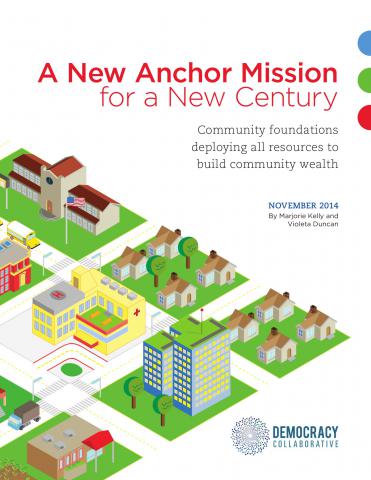
A New Anchor Mission for a New Century: Community foundations deploying all resources to build community wealth

Marjorie Kelly and Violeta Duncan

As the community foundation field reaches the century mark and faces growing pressure on its business model, many communities at the same time are struggling with economic distress. To meet these converging challenges, an innovative group of community foundations are beginning to deepen and shift how they work—adopting an anchor mission that seeks to fully deploy all resources to build community wealth. They are calling on all assets at their disposal—financial, human, intellectual, and political—in service of their communities’ economic well-being. Moving into territory relatively uncharted for community foundations, they are taking up impact investing and economic development—some in advanced ways, others with small steps. This report offers an overview of how 30 representative community foundations, large and small, urban and rural, are working toward adopting this new anchor mission.

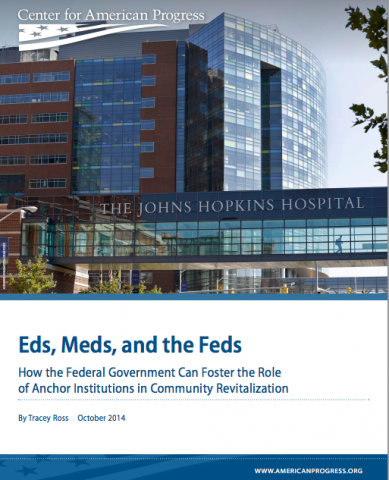
Eds, Meds, and the Feds How the Federal Government Can Foster the Role of Anchor Institutions in Community Revitalization

Tracey Ross
Recognizing that anchor institutions are the largest employers in 66 of the nation’s 100 largest cities, mayors across the nation are working with universities and nonprofit hospitals to foster economic growth in disinvested communities. In this new report from the Center for American Progress, author Tracey Ross explores how federal officials can further enhance the role of such anchor institutions in promoting community economic development. She recommends the use of a framework based on The Democracy Collaborative’s Anchor Dashboard to hold anchor institutions accountable and to help illustrate to Congress and other stakeholders the extent of their impact in communities.

Case Study: Cleveland Clinic (Cleveland, OH)

David Zuckerman
Hospitals Building Healthier Communities: Embracing the Anchor Mission

Despite Cleveland Clinic’s global presence, the vast majority of the system’s operations are based in Ohio, where the system is the largest employer in the northeast part of the state and second largest in the state. Cleveland Clinic’s main campus alone employs more than 26,000 people, has revenues of nearly $4 billion, and procures more than $1.5 billion in goods and services annually. In recent years, it has adopted a variety of anchor strategies, including shifting a percentage of procurement locally and to minority-owned businesses, participating as an anchor partner in a comprehensive neighborhood revitalization effort, implementing childhood wellness programming in local school districts, and positioning itself as a leader in sustainability.

Case Study: University Hospitals (Cleveland, OH)

David Zuckerman
Hospitals Building Healthier Communities: Embracing the Anchor Mission

University Hospitals System comprises the 1032-bed, former academic medical center of Case Western Reserve University, and six community hospitals across Northeast Ohio. The system employs more than 24,000 people and generates revenues in excess of $2 billion annually. A key initiative has been University Hospital’s Vision 2010 project, a $1.2 billion, five-year strategic growth plan that started in 2006. As part of Vision 2010, University Hospitals set separate goals to procure from local, minority- and women- owned businesses, and actively aimed to create new supplier capacity within the city. It also hired a third party to hold it accountable, voluntarily entered into a unique Project Labor Agreement, and has now started to apply this vision to its entire supply chain purchasing. Further still, University Hospitals is involved in other job creation and wealth building initiatives in the community.

Case Study: Henry Ford Health System (Detroit, MI)

David Zuckerman
Hospitals Building Healthier Communities: Embracing the Anchor Mission
Anchored by the 802-bed Henry Ford Hospital in Detroit, Henry Ford Health System has revenues of more than $4.2 billion, employs more than 10,000 people within the city and procures more than $650 million from its Detroit institutions. Henry Ford actively recognizes its position as an anchor institution, working with many partners to increase its impact in the community. Through a multi-institution partnership, Henry Ford has coordinated with Detroit Medical Center and Wayne State University to help revitalize Midtown Detroit by encouraging their employees to live, work, and invest in the same community. It has also helped found a local business incubator at Wayne State, set active goals to procure from local and diverse suppliers, and used its purchasing power to persuade suppliers to relocate to Detroit. Further still, Henry Ford has helped finance education partnerships for high-risk youth, is focused on acquiring and rehabilitating reclaimed properties, and has helped push local infrastructure improvements.

Building the Case for Racial Equity in the Food System

Anthony Giancatarino and Simran Noor
The Center for Social Inclusion

This report from The Center for Social Inclusion examines the effects of housing, school, land, and wage policies on access to healthy food in communities of color. It offers recommendations to surmount these challenges, such as investing in cooperatively owned food enterprises and leveraging dollars from the Affordable Care Act’s community benefit requirements for nonprofit hospitals. The report also includes several reference guides to help community groups identify and confront the particular institutions, policies, and practices that promote structural racial inequity in their food systems. 

Underwriting Good Jobs

Robert Hiltonsmith and Lew Daly
Demos

The third report in a Dēmos research series examining how the federal contracting system has contributed to income inequality illustrates the potential for federal purchasing to instead promote upward mobility. The authors show that by setting higher workforce standards, which require federal contractors to provide living wages, paid sick leave, and the right to collective bargaining, the United States can grow its middle class, increase community wealth, and generate employment. Indeed, the authors estimate that such measures could foster the creation of an additional 260,000 jobs.