Robert Hickey, Jeffrey Lubell, Peter Haas and Stephanie Morse
The Center for Housing Policy and the Center for Neighborhood Technology’s new report by Robert Hickey and Jeffrey Lubell measures how combined housing and transportation costs burden moderate-income households.Looking at the 25 largest metro areas in the United States and using newly available data, the report finds that the problem has not only gotten worse in the last decade but also that moderate-income households are disproportionately saddled by these heavier costs. Notably, transportation costs vary greatly and influence the overall affordability of metro areas significantly. Moderate-income homeowners also carry heavier cost burden than renters. The report offers policy implications of these trends and highlight promising approaches available to local and state governments that help make the combined costs of place more manageable for moderate-income.
Published by the Center for Community Change, this guide for community organizers provides a broad view of the benefits of worker-owned cooperatives and shows how they align with the goals of grassroots organizing groups. Author Nina Daskur demonstrates how cooperatives uphold the principles of solidarity and democracy that are the foundation of community organizing, and are especially relevant in the current economic and political climate. Intended to lay out both the advantages and challenges of a co-operative business model, the paper profiles worker-owned cooperatives in four different service occupations that are typically characterized by low wages –home health care, child care, food service, and housecleaning –and identifies useable mechanisms that organizers could undertake to help advance alternative ownership in communities.
In this report, Reconnecting America focuses on creating complete communities – places where people can live, work, move, and thrive in a healthier, more equitable, and more economically competitive way — and identifies opportunity areas — the places within our cities and regions where we can get a jump-start on this vision.Rating all 366 U.S. Metropolitan Statistical Areas based on indicators in four categories: Living, Working, Moving and Thriving, the authors offer examples of successful policies and strategies for “completing” communities — from zoning changes and suburban retrofits to community benefits agreements.
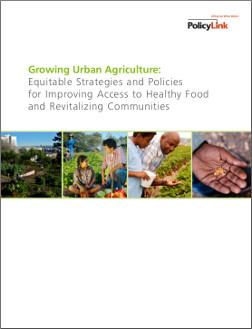
PolicyLink examines how cities across the United States are adopting urban agriculture as a means to address equity issues in our food system and communities. This report details the benefits of urban agriculture, looks at innovative strategies to overcome common challenges, and offers policy recommendations to ensure equity in the growing movement. It lays out how urban agriculture can improve access to healthier food through innovative distribution, processing, and marketing efforts; improve economic health by creating jobs, attracting new business, and creating savings for families; and improve community health by using vacant or underused urban spaces to create safe, clean outdoor spaces for people to gather.
Greening the Bottom Line, a report from the Sustainable Endowments Institute, highlights the role of green revolving funds —an energy-efficient financing mechanism that colleges, universities, and nonprofits have increasingly adopted as a means to fund sustainability initiatives in their buildings and operations. Authors Emily Flynn and Mark Orlowski show that the cost savings of these funds boost the bottom line for institutions while also replenishing the fund for investment in the next round of green retrofits, thus establishing a sustainable funding cycle.
The Center on Wisconsin Strategy’s (COWS) latest report is the third in a series that looks at what works (and what does not) in the green economy. Author Sarah White argues for a more coherent, cross-sectoral and broad-based approach to developing human capital and greening community economic development that is driven by equity, democratic participation, and sustainability. After reviewing the current gloomy realities of green politics, the report offers a number of possible interventions — highlighting best practices and lessons learned — that bring together workers, employers, industry and training systems in and out of typical clean energy sectors.